What Is Slot Volatility? How to Choose Slot Games Based on Volatility
You open two slot games with equally attractive interfaces, place the same bet amount, and spin for roughly the same amount of time. The first game continuously produces small payouts, with the balance moving up and down without being too extreme. The second game remains quiet for quite a while, but a single special combination produces a significantly larger payout. This difference is often related to volatility, an important metric that is easily overlooked because it is less prominent than RTP or the maximum win.
So, what is slot volatility? In simple terms, it describes how payouts are distributed in a game: whether rewards tend to appear more frequently but in smaller amounts, or less frequently with the potential for larger payouts. Volatility does not tell you whether the next spin will win or lose, nor does it guarantee that a high-volatility game will hit a jackpot if you play long enough. The practical value of this metric is that it helps players choose a game pace that suits their budget, entertainment time, and ability to tolerate sequences of spins without a payout.
When looking for games at V9Bet, players should treat volatility as a filtering criterion, not a prediction signal. A game that suits someone else may not necessarily suit you. Someone who wants to play steadily for a relatively long period may have different needs from someone who accepts high volatility in exchange for a more concentrated payout structure. Identifying a suitable slot playing style beforehand can help narrow down your choices before considering the theme or maximum win.
Key Points to Remember
- Volatility describes how rewards are distributed; it does not predict the outcome of the next spin.
- Low-volatility slots generally offer smaller payouts at a more consistent pace, while high-volatility slots tend to have longer quiet periods and potentially larger payouts.
- RTP, hit frequency, volatility, and maximum win are four different concepts.
- Game selection should be based on your budget, bet size per spin, playing time, and ability to accept losing streaks.
- Increasing your bet after a loss does not improve the probability of the next spin.
- If the provider does not disclose volatility, it is better to observe the game in demo mode or at a low bet level; do not draw conclusions from just a few dozen spins.
What Is Slot Volatility and What Does This Metric Tell You?
Volatility, sometimes referred to by game providers as variance or volatility, reflects the degree of difference between payouts and the frequency at which they occur within a game's mathematical design. A low-volatility game generally distributes rewards across more frequent, smaller payouts. A high-volatility game tends to concentrate value into rarer outcomes, meaning the balance may go through longer periods of decline before a significant payout appears.
It is important to pay attention to the word "tend." Slots use random outcome-generation mechanisms, so a short playing session may not resemble the game's long-term characteristics. You may experience many non-winning spins in a game classified as low volatility, or receive an early payout in a high-volatility game. A volatility label is not a payout schedule, and certainly not a promise that the game will compensate you after a certain number of losses.
This concept is most useful when used to estimate the playing experience. If two games have the same minimum bet, a game with stronger volatility generally requires players to be prepared for a larger range of balance fluctuations. Someone who feels uncomfortable when their account decreases quickly, even when it remains within their predetermined limit, may be better suited to a game with a steadier pace. Conversely, someone who finds small payouts less engaging may consider higher volatility, but must accept the risk that their budget may run out sooner.
|
Volatility Level |
Typical Payout Frequency |
Typical Payout Size |
Balance Experience |
More Suitable For |
|
Low |
Relatively frequent |
Small to medium |
Less pronounced fluctuations |
Players who prioritize playing time and a steady pace |
|
Medium |
A mix of small payouts and quiet periods |
More varied |
Moderate fluctuations |
Players who want a balance between game pace and reward potential |
|
High |
Less frequent, with potentially long dry spells |
Potentially concentrated in larger payouts |
Strong fluctuations |
Players who accept higher risk and sessions that may end quickly |
The table above describes general tendencies, not a guarantee for any individual session. The way volatility is presented is also not completely standardized among providers. Some providers use three levels—low, medium, and high—while others use a five-level scale, lightning-bolt symbols, or their own terminology. When distinguishing V9Bet slot volatility, players should open the information section or the game's own guide to read the label provided by the game developer rather than making assumptions based on colors, themes, or jackpot imagery.
Why Is Volatility Different from RTP and Hit Frequency?
New players often combine different figures into a single question: which game is "easier to pay"? In reality, RTP, hit frequency, and volatility address three different issues. RTP refers to the theoretical return percentage over a very large number of plays under the game's designed conditions; hit frequency describes the proportion of spins that produce a payout; while volatility indicates how widely those payouts are distributed. If you are still confusing theoretical percentages with the result of an individual session, the explanation of RTP in slot games is a suitable next step.
A game with a relatively high RTP can still have high volatility. The theoretical return may be concentrated in rare combinations, bonus rounds, or large prizes, meaning a player's short session can still experience a significant decline. Conversely, a low-volatility game may create the impression of "frequent wins," while many payouts are smaller than the bet placed on that spin. Seeing a winning animation does not necessarily mean that the balance is increasing.
Hit frequency can also create an illusion. If a game records many winning outcomes but most of them have low values, the sounds and animations may make players feel that they are experiencing a good streak. A more objective way to check is to look at the balance after a group of spins and compare the total amount wagered with the total amount returned, rather than counting how many times the screen displays a winning effect.
|
Metric |
Question the Metric Answers |
What It Cannot Tell You |
|
RTP |
In theory, how much does the game return over a very large sample of plays? |
How much a specific session will return |
|
Hit Frequency |
How many spins can produce a payout according to the design? |
Whether that payout is larger than the bet |
|
Volatility |
Are payout values distributed narrowly or widely? |
Whether the next spin will win or a large payout is about to occur |
|
Maximum Win |
What is the maximum win allowed under the game's rules? |
Whether a player is realistically likely to reach that maximum during a session |
A higher maximum win naturally attracts more attention, but it does not automatically prove that a game has high volatility or is suitable for choosing a jackpot slot game. Jackpots may also be designed using fixed, progressive, or separate bonus-round mechanisms. To understand the game correctly, you need to read its paytable and rules rather than using a single advertised figure as a substitute for the game's overall structure.
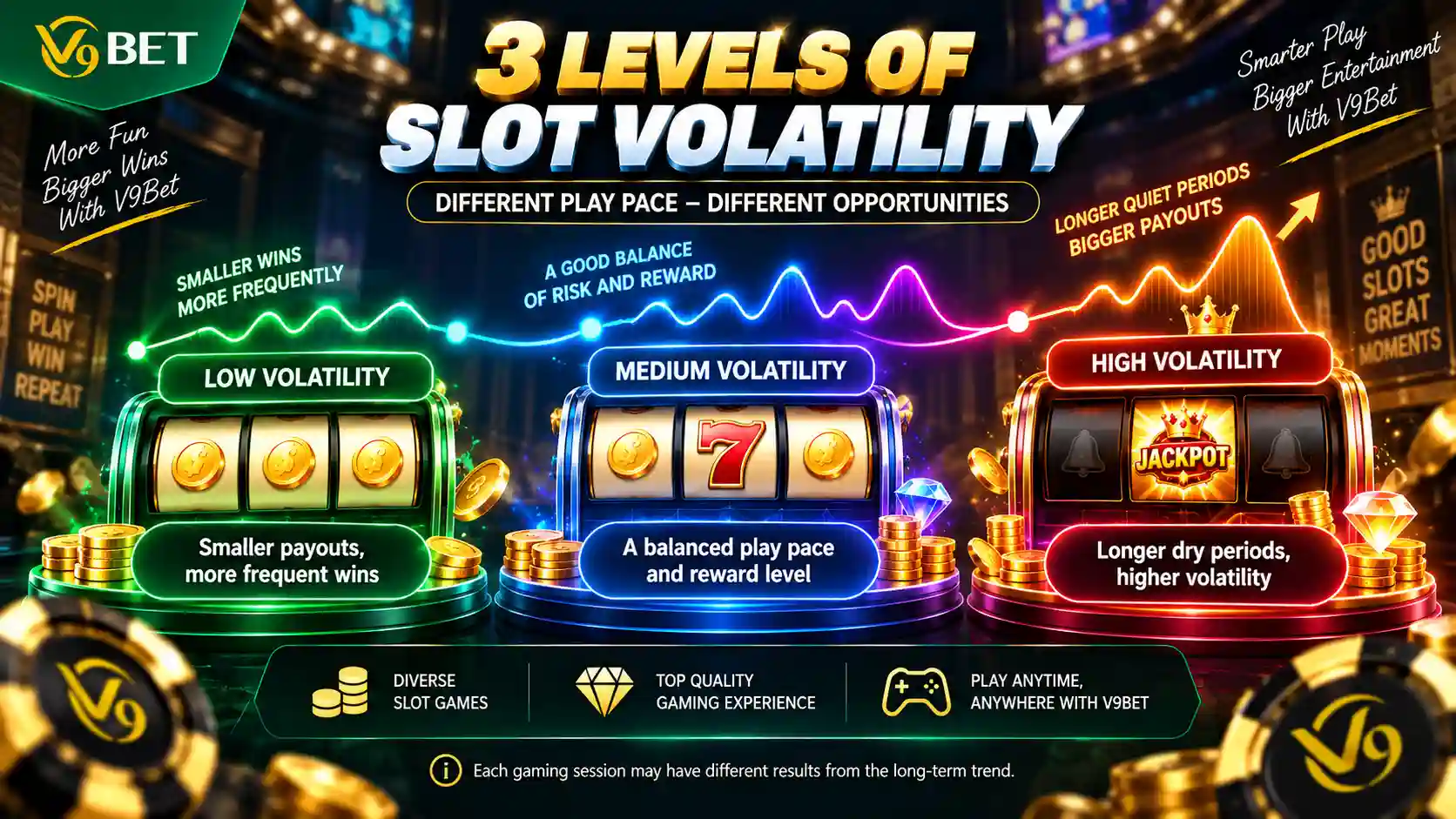
Three slot volatility levels: low, medium, and high
Distinguishing Steady-Paying Games from High-Volatility Games
Steady-paying games generally create more frequent feedback during a session: small combinations appear relatively often, the balance is partially replenished, and players may feel that the spinning session lasts longer. The advantage of this type of game is not guaranteed profit, but rather a less intense pace of play when the bet size is kept stable. Players who enjoy observing features, graphics, or bonus rounds without wanting their balance to fluctuate too quickly may find this group more comfortable.
High-volatility games take a different approach. Many spins may not produce a significant payout, while a small number of outcomes contain much of the potential reward. The waiting period can easily lead players to believe that the game has "taken enough" and is about to pay. This is a common psychological trap. Each valid spin is determined according to the game's mechanism; previous results do not create a debt that the machine must repay on the next spin.
Look at the Paytable and Special Features
If the game discloses its volatility, that is the information that should be prioritized. When there is no clear label, the paytable and feature structure can only help form an initial assessment. A game with many symbols offering small payouts, wilds that appear through relatively simple mechanisms, and bonus rounds that do not heavily depend on rare combinations may feel more consistent. A game that concentrates its potential in large multipliers, rare symbols, consecutive feature chains, or a maximum prize may fluctuate more strongly.
However, these signs should not be turned into a formula. Two games with similar interfaces may use completely different mathematical models. The presence of free spins or multipliers alone is not enough to classify volatility. The most reliable source remains the information provided by the developer within the game itself.
Use Demo Mode for the Right Purpose
Demo play helps users become familiar with the paytable, how features are triggered, bet levels, and spin speed. It also provides an initial feel for the game's pace. However, a few dozen or a few hundred spins are not enough to accurately "measure" volatility, nor do they prove that a game is currently hot or cold. A short sample can easily deviate from the game's long-term characteristics.
If V9Bet or the provider displays a demo mode for the game you are interested in, use it to learn the rules rather than to predict a real-money session. A favorable result in the demo version does not create an advantage for a subsequent session. When switching to real money, the most important consideration remains the amount of money you are prepared to lose completely.
How to Choose Jackpot Slot Games Based on Practical Goals
There is no single "best" game for everyone. A reasonable selection process starts with three questions: how much money are you allocating to the session, how long do you want to play, and how much balance reduction can you tolerate? Volatility only has meaning when considered alongside these three limits. Choosing a game first and then trying to adjust your budget around it can leave you less prepared.
If the goal is entertainment over a relatively long period, low- or medium-volatility games are generally easier to control. The bet per spin needs to be small enough that a dry spell does not immediately disrupt your plan. If the goal is to experience the large-reward mechanics of a high-volatility game, you should accept from the beginning that the session may end quickly without the expected feature appearing. That is a risk cost, not a reason to deposit more.
|
Session Goal |
Volatility to Consider |
How to Set the Bet |
Risk to Accept |
|
Prioritize playing time |
Low to medium |
Small and fixed |
The balance may still decline gradually; payouts are generally not large |
|
Balance pace and rewards |
Medium |
Small to medium, without changing based on emotions |
You may experience both quiet streaks and medium-sized payouts |
|
Accept fluctuations for larger features |
High |
Significantly smaller than for a steady-paying game |
The budget may run out before the feature appears |
|
Not sure about your preference |
Demo play or the lowest level |
A separate trial budget |
A short sample does not fully represent the game's mathematical model |
The phrase "jackpot slot" can easily cause players to focus only on the jackpot or maximum win. However, a suitable choice should also consider the probability of accessing a feature, bonus-round rules, minimum bet, and personal budget limit. If a large prize is attractive but the bet size means you can only make a very small number of spins, that game may not fit the entertainment goal of the session.
When browsing the game selection at V9Bet, consider filtering by a provider or theme you understand, then open the information for each game to check its volatility, RTP, paytable, and feature conditions if these details are disclosed. For example, the featured Habanero slots for September can be used as an example of how to consider RTP, volatility, and bonus features together before making a selection. Do not assume that every game in the same lobby operates in the same way. Each title has its own mathematical model.
Tips for Playing Slots According to Volatility Without Falling into the Illusion of Control
The most useful slot-playing tips based on volatility focus on managing the way you play, not manipulating the outcome. You can choose the bet size, duration, stopping point, and type of game; you cannot make a specific combination appear by changing your clicking speed, stopping the reels at the right moment, or switching games after a losing streak.
A practical approach is to divide your session budget into enough betting units to give the game time to demonstrate its pace without forcing you to increase your bet. For example, if your entertainment budget is a fixed amount, choose a bet size so that an unfavorable sequence of results does not exceed your limit within just a few minutes. With high-volatility games, the bet size should be more cautious because the potential decline can be larger.
Setting a loss limit before starting is also more important than choosing a "perfect spin point." When you reach the limit, end the session even if you believe the feature is about to appear. If you achieve a significant win, you may separate the initial funds or stop at a predetermined level. Continuing simply because you are winning can easily lead to increased bets and giving the entire balance back to the game.
Keep the Bet Size Stable to Assess the Experience Properly
Changing the bet amount constantly makes it harder to evaluate the effectiveness of a session and often amplifies emotions. After several losing spins, doubling the bet can create the feeling that you are "taking advantage of the moment when the game is about to pay," but the probability does not improve simply because you have just lost. If a payout appears at a higher bet level, it is the random result of that particular spin and does not prove that a chasing strategy was correct.
A stable bet size also makes it easier to compare two games fairly. When testing low- and high-volatility games with completely different bet amounts, the balance experience becomes distorted. Players may confuse the effect of bet size with the effect of volatility.
Do Not Use the Number of Spins as a Promise of Recovering Your Money
The thought, "Just a few dozen more spins and it will surely come back," can sound familiar, especially after many spins without a payout. However, slots are not required to balance results within a short session. RTP only converges theoretically over an extremely large sample and is not a personal refund mechanism.
If a session has reached its stopping point, leaving the game remains the appropriate action even if another player's next spin produces a prize. You are not losing a reward that already belonged to you; you are simply choosing not to put additional money into an unknown outcome. This distinction helps separate controlled entertainment from chasing losses.
How to Allocate Your Bankroll Based on Game Pace Instead of Emotions
Bankroll management does not turn slots into an investment with an advantage. It only limits potential losses and helps keep the session within your financial means. Money used for slots should be separate from living expenses, emergency funds, and borrowed money. If losing that amount would force you to reduce spending on essential needs, the budget is too high. Players who want to establish clearer limits can refer to slot bankroll management from basic to advanced strategies.
Suppose you allocate a fixed amount for an entertainment session. With a low-volatility game, you can use a small bet and keep it unchanged to prioritize playing time. With a high-volatility game, the bet per spin needs to be even lower or the playing period needs to be shorter. There is no percentage rule that works for everyone because minimum bet sizes, income, and risk tolerance differ from person to person.
|
Before the Session |
During the Session |
When Ending |
|
Set the maximum budget you can afford to lose |
Keep the bet within the predetermined limit |
Stop when the time limit or loss limit is reached |
|
Choose an appropriate volatility level |
Do not deposit more money to recover losses |
Record the total amount wagered and the remaining balance |
|
Set a playing time limit |
Take a break when you become frustrated or start increasing your bet |
Do not immediately return because you regret a losing streak |
A concerning sign is when you start caring more about recovering losses than enjoying the game. At that point, information about volatility can easily be misused: low-volatility games may be viewed as a place to "gradually recover," while high-volatility games may be seen as an opportunity to "make one big attempt to get it back." Both ways of thinking ignore randomness and push the bet size beyond the original plan. Stop immediately when your goal changes from entertainment to recovering lost money.
Common Mistakes When Distinguishing V9Bet Slot Volatility
The most common mistake is evaluating volatility based on a short playing session. One large payout does not turn a game into an "easy-to-hit" game, just as a losing streak is not enough to prove that a game has high volatility. To classify a game, prioritize the official information in the game rules section; personal observations should only be treated as supplementary data.
The second mistake is equating high volatility with high RTP. These two metrics have different meanings. A game with large prizes can still have a lower theoretical return rate than a game that pays more steadily, and vice versa. If the information section displays multiple RTP versions, players need to understand that the configuration may vary by platform; use only the figure currently disclosed in the game you are playing.
Another misunderstanding comes from bonus-round purchase features. Paying to enter a feature directly does not make volatility disappear. The cost of each participation is generally higher than that of a basic spin, so the balance may fluctuate more sharply. Only use such a feature if you clearly understand the price, rules, and budget limit; never treat it as a shortcut to profitability.
Finally, some players choose games based on word of mouth that a particular time or lobby is currently "paying." Another player's results do not provide evidence about your own spins. A history of large wins may be visually appealing, but it cannot replace the game's mathematical information or responsible budget discipline.
When Should You Switch Games and When Should You Stop Completely?
You may consider switching games when you realize that the volatility does not match your intended goal, you do not understand the payout rules, or the minimum bet is too high relative to your budget. Changing games in this situation is an adjustment to the playing experience. It is different from continuously jumping between multiple games because you believe the next game will recover the money you just lost.
You should stop completely when you reach your money or time limit, when you begin increasing your bet outside the original plan, or when your emotions shift toward frustration and wanting to recover losses. Stopping is also necessary if you can no longer keep track of the total amount you have wagered. A good slot session should not be measured by whether you win or lose, but by whether the player remains in control of their decisions without affecting their everyday finances.
On V9Bet or any other platform, any available limit-setting tools should be used proactively. Players can also set their own alarms, separate entertainment funds, and avoid saving payment methods in advance if they find themselves regularly breaking their plans. If playing causes financial pressure or becomes difficult to stop, the appropriate choice is to take a break and seek support, not to switch to a lower-volatility game.
Frequently Asked Questions About Slot Volatility
What Is Slot Volatility?
Slot volatility is a metric that describes how payouts are distributed. Low volatility is generally associated with smaller payouts appearing more consistently, while high volatility is generally associated with greater gaps between larger payouts and stronger balance fluctuations. This metric does not predict the outcome of the next spin.
Are High-Volatility Slots More Likely to Hit a Jackpot?
This cannot be concluded from the volatility label alone. High-volatility games generally concentrate more value in rarer outcomes, but the jackpot mechanism, activation probability, and maximum win depend on the individual game's rules. "Greater potential" does not mean "easier to hit."
Which Volatility Level Should Beginners Choose?
Beginners may find low- or medium-volatility games easier to understand because the balance tends to fluctuate less sharply. However, they should still choose a small bet size, read the rules, and set limits. A low-volatility label does not guarantee that a session will be profitable or free from losing streaks.
Does a High RTP Mean the Game Has Low Volatility?
No. RTP describes the theoretical return over a very large sample of spins, while volatility describes the distribution of payouts. A game with a high RTP can still have high volatility if most of its value is concentrated in rare outcomes.
Can You Identify Volatility Simply by Playing in Demo Mode?
Demo play provides a feel for the game's pace and helps you learn the rules, but a short sample is not enough to accurately classify volatility. You should prioritize the volatility label or documentation provided by the game developer. If no data is available, make only cautious observations and do not treat the experience from a few sessions as evidence.
Is Increasing the Bet After Several Losses Reasonable?
No. Previous losses do not make the next spin more likely to produce a payout. Increasing the bet when trying to recover losses only increases the amount at risk and can cause the budget to run out more quickly, particularly in high-volatility games.
Should You Choose Jackpot Slot Games Based on Maximum Win or Volatility?
You should not choose based on a single criterion. Consider volatility, RTP if disclosed, the paytable, jackpot rules, minimum bet, and the cost of activating features together. More importantly, these metrics should fit your budget and intended playing time.
Expert Conclusion
Understanding what slot volatility is helps players choose an experience that matches their preferences: steady-paying games to prioritize playing pace, medium-volatility games for balance, or high-volatility games when they accept longer quiet periods and larger balance fluctuations. Volatility is not a prediction tool, nor is it a secret to winning. It simply describes the risk structure of a game.
When choosing slots at V9Bet, read the information provided for each game and clearly distinguish volatility from RTP, hit frequency, and maximum win. Only then should you determine your bet size based on the budget you can afford to lose, rather than on the feeling that the game is about to pay. Keeping the bet stable, setting a stopping point, and avoiding chasing losses remain three practical principles. If a game makes you break your plan in order to continue, the answer is not to find a new trick. It is to stop.